Hey, I want to share something that happened to me recently about What Does Range Mean in Math. I was chatting with a friend when this term suddenly popped up, and honestly, I had no clue what it meant at first. I kept thinking, “Am I missing something here?” It was a bit confusing, and I didn’t want to respond the wrong way.
So, I decided to look into what range means in math and figure out its meaning and context. After learning about it, I realized how important it is to understand these terms to avoid awkward situations in conversations. I handled it by learning the proper meaning and responding confidently. Now, I feel ready whenever I see “range” in chats, social media, or discussions about math.
Let’s dive in!
Quick Answer:
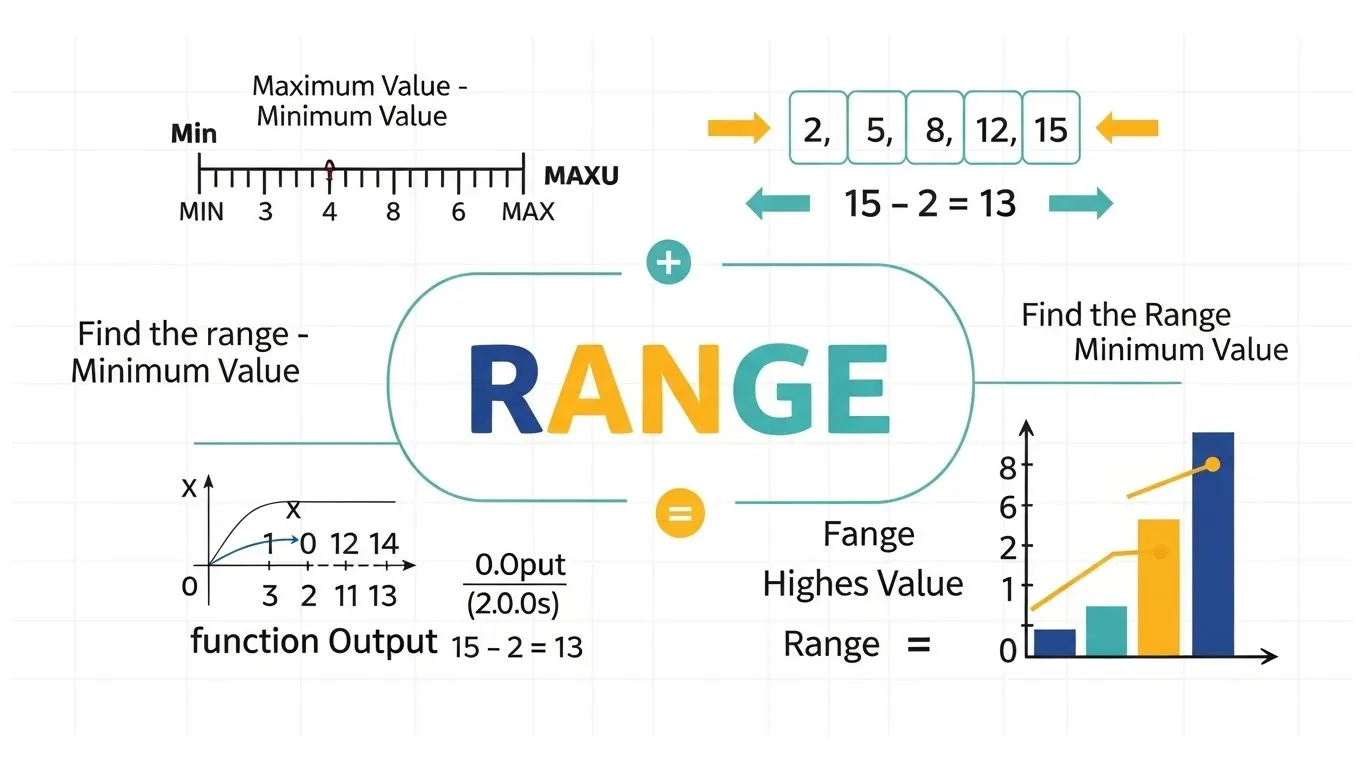
Range in math means the difference between the largest and smallest numbers in a set. It’s a simple, straightforward way of describing how spread out the values are.
🧠 What Does Range Mean in Math?
In math, the range tells you how much the numbers in a dataset vary.
You calculate it by subtracting:
Range = Largest number − Smallest number
That’s it!
Example:
If your numbers are: 4, 7, 10, 12,
Largest = 12
Smallest = 4
Range = 12 − 4 = 8
A bigger range means the numbers are more spread out. A smaller range means they’re closer together.
In short: Range = Max − Min = How spread out the numbers are.
📱 Where Is “Range” Commonly Used?
You’ll see range used anywhere people study or talk about data:
- 🎓 Math class (algebra, statistics, test prep)
- 📘 Homework help forums
- 🧠 Study groups & tutoring chats
- 📈 Data science basics
- 🧮 Standardized tests like SAT, ACT, GRE
- 💬 Casual conversations about numbers (“What’s the temperature range this week?”)
It’s completely formal, educational, and data-friendly—not slang, and definitely not flirty!
💬 Examples of “Range” in Conversation
Here are realistic chat-style examples to show how people use it:
A: i don’t get this stats question 😭
B: what’s confusing?
A: it says find the range
B: oh that’s just max minus min 👍
—
A: is the range supposed to be 15?
B: depends… what r ur biggest and smallest numbers?
—
A: omg this dataset is wild
B: what’s the range??
A: 102 😳
—
A: what’s the range of the temps this week?
B: like 45–72 i think
—
A: teacher said the range is huge
B: yeah ur numbers are super spread out
—
A: does this list even HAVE a range
B: yep as long as there’s a highest + lowest
—
A: i keep forgetting how to calc range lol
B: it’s literally subtraction 😂
🕓 When to Use and When Not to Use “Range”
✅ When to Use “Range”
- When talking about data sets
- When doing math or statistics homework
- When describing variability
- When comparing temperatures, scores, or measurements
- When someone needs a quick summary of spread
❌ When Not to Use “Range”
- In formal writing where “spread” or “variation” may be clearer
- When exact statistical terms like variance or standard deviation are expected
- In business reports unless your audience is math-savvy
- When the numbers involve categories (range only works on actual numbers)
Comparison Table
| Context | Example Phrase | Why It Works |
| Homework Chat | “The range is 9 bc 14 − 5.” | Clear and simple for math discussions. |
| Study Group | “Check the range first to see how spread the data is.” | Helps everyone understand variability. |
| Classroom | “Calculate the range of these values.” | The standard math terminology. |
| Everyday Talk | “What’s the temp range today?” | Casual but accurate. |
| Work/Report | “The values vary between 10 and 35.” | More formal; avoids math jargon. |
🔄 Similar Words or Alternatives
| Term | Meaning | When to Use |
| Spread | General distance between values | Everyday, casual speech |
| Interval | A span between two limits | Math, plotting, timelines |
| Variance | Statistical measure of spread | Academic or data science settings |
| Standard deviation | Shows how far numbers are from average | More technical analyses |
| Domain | All possible input values | Functions, algebra, graphing |
| Distribution | How data values are arranged | Statistics & data interpretation |
❓ FAQs About Range in Math
1. Is range the same as domain?
No!
- Range (statistics) = max − min
- Range (functions) = all possible output values
- Domain = all possible input values
Context matters.
2. Can the range be negative?
No.
Since it’s calculated as largest − smallest, it will always be zero or positive.
3. What if all numbers are the same?
Then the range is 0, because the largest and smallest values match.
4. Can you find range with decimals or negatives?
Absolutely.
It still works:
Example:
Numbers: −3, 2.5, 10
Range = 10 − (−3) = 13
5. Why is range useful?
It quickly shows:
- how consistent the data is
- how extreme the highs and lows are
- whether there’s a big spread or a tight cluster
It’s one of the simplest ways to describe data variability.
6. Is range always enough to analyze data?
Not always.
Range only uses two numbers (max and min), so it ignores everything in between. For deeper analysis, you’d also look at the mean, median, variance, or standard deviation.
7. Is “range” only used in math class?
Nope!
People use it in real life all the time to describe temperatures, prices, salaries, test scores, and more.

Hi, I’m William Austen, the author behind Aniverssy.com. I love sharing creative ideas to make anniversaries and special moments unforgettable. My goal is to inspire readers to celebrate life with meaning and joy.